

Mix it, match it. Write it down.
Two hours learning to build block-print colours from binder and pigment, match a target shade, and record a recipe anyone on your team can repeat.


Make at Creatis
Color Making Workshop
Color Making Workshop
Couldn't load pickup availability
A hands-on workshop to learn how to create, adjust, and record colors for block printing using a simple, repeatable system. In most studios, color lives in memory—“a little more yellow,” “slightly warmer.” It works… until it doesn’t. This workshop turns that instinct into a system.
In this 2-hour workshop, you’ll learn how to build colors using binder and pigments, match a target shade, and record it so it can be recreated—by you or anyone on your team.
No lab setup. No rigid formulas. Just a practical method designed for real studio conditions.
What will you make?
What will you make?
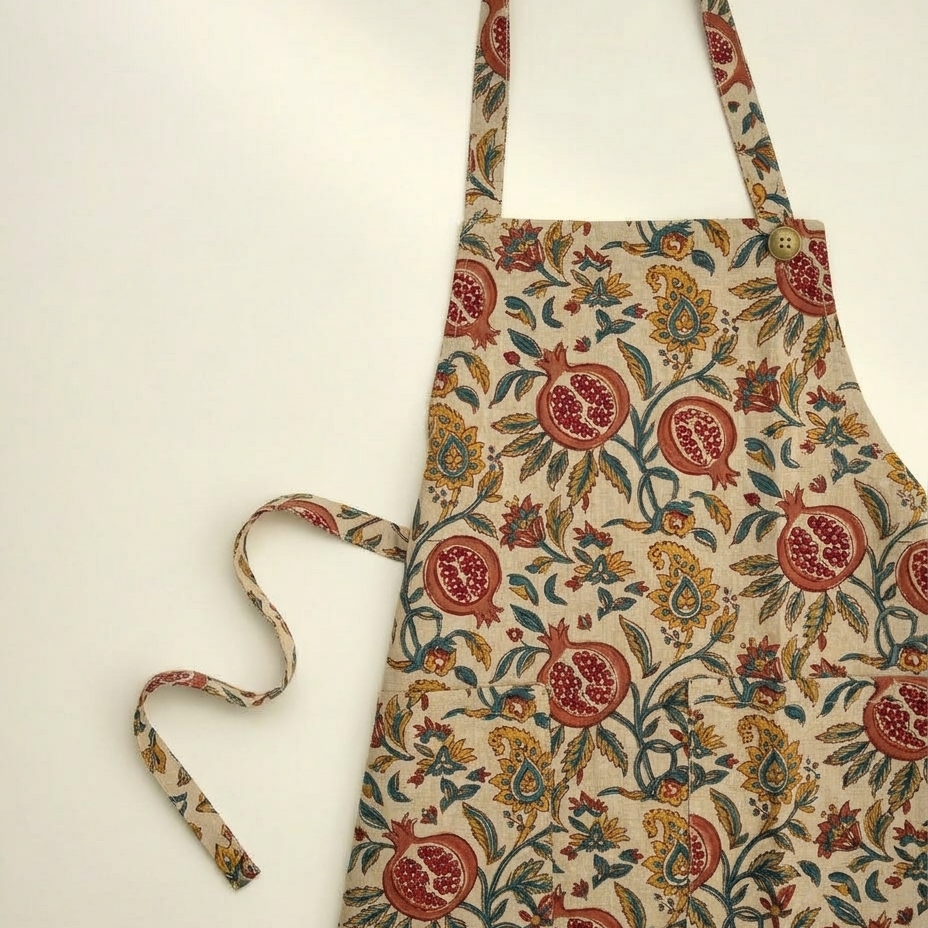
Apron: Includes 1 Apron in a durable casement cotton in your colors. Ready next business day for pickup or free delivery within Jaipur.
What you’ll do
What you’ll do
- Mix your own colors using pigment dyes
- Match a target color by eye
- Print and evaluate swatches
- Document your recipe using the Match method
How long is the workshop?
How long is the workshop?
The workshop is an immersive, hands-on session lasting approximately 2 hours.
Who is this for?
Who is this for?
Open to all skill levels, ages 21+ — ideal for design professionals, studios looking to develop colours in-house, or anyone curious about India’s craft heritage. No prior experience required.
What you'll learn
What you'll learn
- How to control color using simple tools
- How to adjust tones confidently
- How to create repeatable recipes
- How to scale color from sample to production
What to wear
What to wear
Comfortable clothing suitable for a hands-on workshop.
What is the cancellation policy?
What is the cancellation policy?
You can receive a full refund if you cancel your reservation at least 3 hours in advance for groups of fewer than 4, or 24 hours in advance for groups of 4 or more, prior to the scheduled workshop time.




Four steps to a repeatable colour


What the print table tells us
Every colour ordered at a workshop station is logged in the Color Menu.
A visual story
From root
to binder
For centuries, Indian printers have built colour through plant dyes, mineral compounds, mordants and resist pastes. Today, many print tables use prepared pigments held to cloth by a binder. The two methods solve the same problem in very different ways: how to make colour stay.
Part one · Before pigment
Colour that grew in the field
In many traditional Indian printing processes, colour was developed through a sequence of treatments rather than applied as a ready-made coloured paste. A printer could stamp a mordant—often a metal salt such as alum—onto selected areas, then immerse the cloth in a dye bath. The mordant helped the dye bond to the fibre and influenced the resulting shade. Other methods used resist pastes to keep parts of the cloth from taking up dye. The exact sequence varied by region, dye and design. [1]
A traditional printing sequence: prepare and clean the cloth, apply tannin or mordant where required, print mordants or resists, dye, then wash and dry. The order and number of stages vary by technique. Washing and dyeing can use substantial amounts of water, making access to water an important practical consideration for textile-processing communities. [1]
Part two · How it changed
A long history in six stops
- Medieval periodDye
Indian prints reach Egypt
Indian cotton textiles made with block printing, mordant dyeing and resist techniques survive among finds from Fustat, near Old Cairo. Gujarat-made examples in museum collections date to the 13th–14th centuries, while written records point to trade between Gujarat and Egypt as early as the 10th century. [2]
- 17th–18th c.Dye
Indian printed cottons travel widely
Indian painted and printed cottons became highly sought-after in global trade. The histories of particular regional centres, including Sanganer and Bagru, should be treated separately rather than assigned a single origin date.
- 1856Synthetic
Mauveine changes dye-making
William Henry Perkin discovered mauveine while experimenting with coal-tar derivatives. It became the first commercially successful synthetic organic dye and helped launch a new industry. [3]
- 1869 onwardSynthetic
Natural dyes gain synthetic counterparts
Synthetic alizarin, developed in the late 1860s, offered an industrial alternative to madder. Synthetic indigo later transformed the global indigo trade. These changes affected the economics and availability of colour, though adoption varied by place and textile practice. [4]
- Modern eraPigment
Pigments need a binder
Unlike dyes, textile pigments do not dissolve into or bond directly with cotton in the same way. A binder forms a film that holds pigment particles on the fabric. The history of pigment-printing binders is technically complex, so this article does not assign a single invention date.
- TodayPigment
Two approaches, different strengths
Modern pigment printing can offer a broad palette and avoid the large dye baths and post-print washing used in many dye processes. It still requires a suitable binder and correct curing. Natural-dye printing remains an active craft, not simply a stage left behind.
Part three · Dye vs pigment
One goes in, the other sits on top
In textile printing, a dye is a colorant that can interact with the fibre at a molecular level. A pigment is an insoluble coloured particle that generally has little affinity for cotton on its own. A polymer binder forms a film that anchors the pigment to the fabric. The precise feel and fastness depend on the pigment, binder, fabric and curing conditions. [5]
Dyed cotton. The colourant interacts with the fibre rather than relying on a surface binder film. The process may require a dye bath, heat, mordants or other auxiliaries, depending on the dye system.
Pigment-printed cotton. Pigment is mixed with a suitable binder and auxiliaries. It can be used on many fibre types, but performance depends on the formulation and fabric. Printed areas may feel firmer where the binder film sits.
Part four · Primer
What is in the bowl
A pigment print paste must carry the colour, have a workable consistency, adhere to the fabric and achieve the required wash and rub fastness. Formulations vary: a paste may contain pigment dispersion, binder, thickener and other auxiliaries, but not every product uses the same ingredients. [5]
Binder
An acrylic emulsion. It looks milky white in the bowl and dries to a clear film. This is the "white base" you mix into.
Thickener
Controls viscosity so the paste transfers cleanly from the block and helps produce a defined edge. Formulations vary; this page does not make a universal claim about older recipes.
Pigment
Concentrated colour, already dispersed in water. You add it by the millilitre. A little goes a long way.
Fixer & softener
Depending on the formulation, auxiliaries may improve fastness or handle. Use only those recommended by the binder manufacturer.
Try it
Add pigment to 100 ml of binder
Pick a pigment and move the slider to explore an illustrative tint curve. The colour changes are generated by a simplified screen model, not measured from actual pigment samples. Real mixtures depend on pigment strength, concentration, binder opacity, fabric and curing. Wet paste can look different from the cured print, but the direction and size of that change are product-dependent.
Screen colours are a guide. Always test on a scrap of the same cloth and let it dry before judging.
Primer · The method
Mixing a colour, step by step
Measure the binder first
Start with a known amount of white base, say 100 ml. Every recipe is written per 100 ml so it scales cleanly.
Add the main pigment a little at a time
Use a syringe or dropper. You can always add more. You cannot take it out.
Mix until there are no streaks
Stir and fold for a full minute. Streaks in the bowl become streaks on the cloth.
Adjust with small touches
Shift the hue with a neighbour colour. Mute it with its opposite, or with a drop of brown or black.
Test, dry, then judge
Print a sample on the same fabric and let it dry and cure fully. Judge the actual swatch rather than assuming the dry colour will always be darker.
Print, then cure as specified
Follow the technical data sheet for the exact binder, including drying, curing temperature and time. Do not assume a household iron is sufficient. Test wash and rub fastness on a sample before production. [5]
Write it down
Note every millilitre. A colour you can't repeat is a colour you will have to find again.
From the Creatis colour sheet
Real recipes, per 100 ml of binder
These example ratios are taken from the Creatis calibration sheet behind Match and normalised by the page to 100 ml of binder. They are studio-specific starting points, not universal formulations or independently verified recipes. Confirm pigment concentration and binder compatibility, then test the result on the actual fabric.
Rules of thumb
What the print table teaches
Lighter often means less pigment
With an opaque or milky binder, reducing pigment can produce a lighter shade. The result depends on the binder and pigment system.
Black is the loudest
A few drops of black can take over a whole bowl. Add it last and in the smallest amounts.
Complementary colours mute
Mixing complementary colours can reduce saturation and create browns or greys. The result depends on the pigments; small additions and swatch tests are safest.
Respect the binder limit
Excess pigment can compromise film formation, adhesion or fastness. Follow the supplier’s recommended pigment-to-binder ratio rather than increasing colour indefinitely.
Further reading
Sources and notes
The historical sections draw on museum research and scholarly accounts of Indian printed textiles and synthetic dyes. The technical guidance on modern pigment printing is general; the correct process for a particular print paste must come from its manufacturer’s technical data sheet.
- [1]
Yael Rosenfield, The Metropolitan Museum of Art
Indian Block-Printed Textiles: Past and Present — traditional preparation, mordant and resist methods, and surviving Indian textile practices.
- [2]
Ayesha U. Shaikh, The Metropolitan Museum of Art (2023)
Made in India, Found in Egypt: Red Sea Textile Trade in the Thirteenth and Fourteenth Centuries — Gujarat textiles, Fustat finds and evidence for trade.
- [3]
Scientific Reports (2017)
Reconstructing the historical synthesis of mauveine from Perkin and Caro — the 1856 discovery and significance of mauveine.
- [4]
British Journal for the History of Science
The British chemical industry and the indigo trade — synthetic alizarin, synthetic indigo and changes in the dye trade.
- [5]
Flychem Industries, technical overview
Textile pigment printing: binder, thickener and cure — general pigment-paste components and curing considerations. For production, consult the specific binder supplier’s technical data sheet.
The colour mixer is an educational visualisation, not a calibrated chemical model. The Creatis recipes are internal calibration examples and should be validated on the intended fabric and materials.
Match turns a target colour into a recipe · bizemind — Built by Creatis
Need a colour matched for production?
Our masters match your shade in pigment, record the recipe and print it consistently, from a single sample to a full run.